
Versione italiana: EIC - Interviste
Referees:
- Danielle Borra s. (Iaido 7th Dan Kyoshi, Kendo 5th Dan)
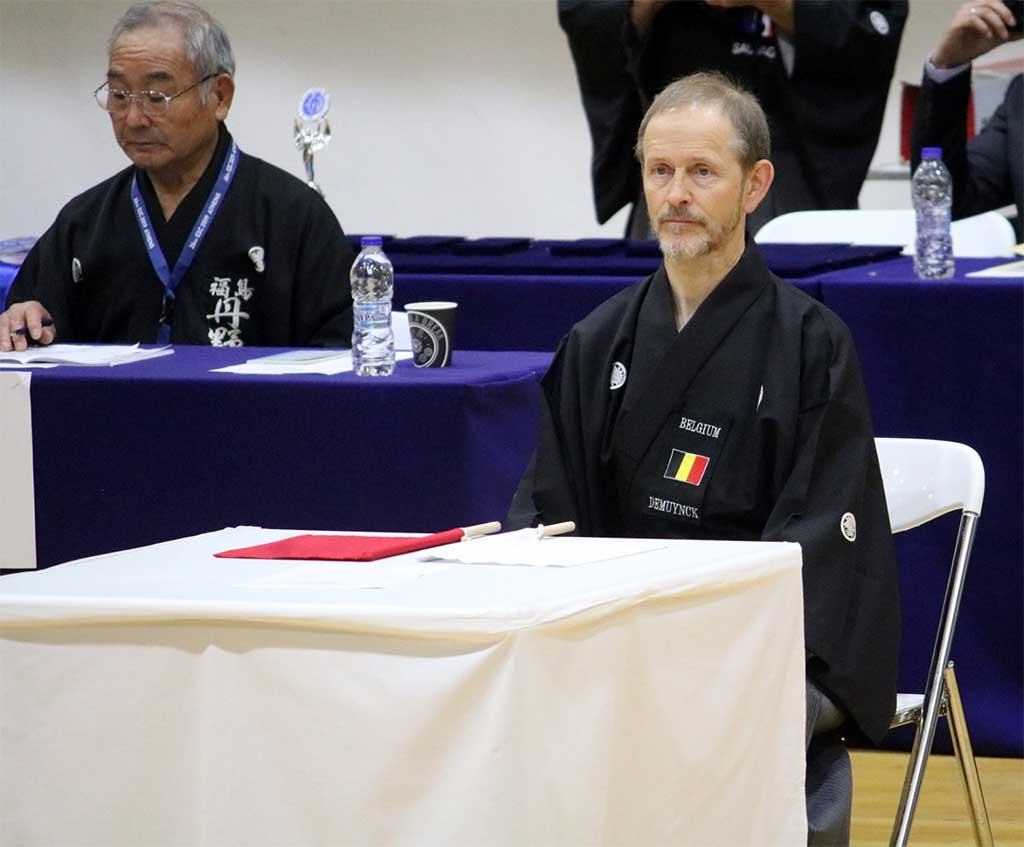
- Patrik Demuynck s. (Iaido 7th Dan Kyoshi, Jodo 6th Dan Renshi)
- Rene van Amersfoort s. (Iaido 7th Dan Kyoshi, Jodo 8th Dan Kyoshi, Kendo 5th Dan)
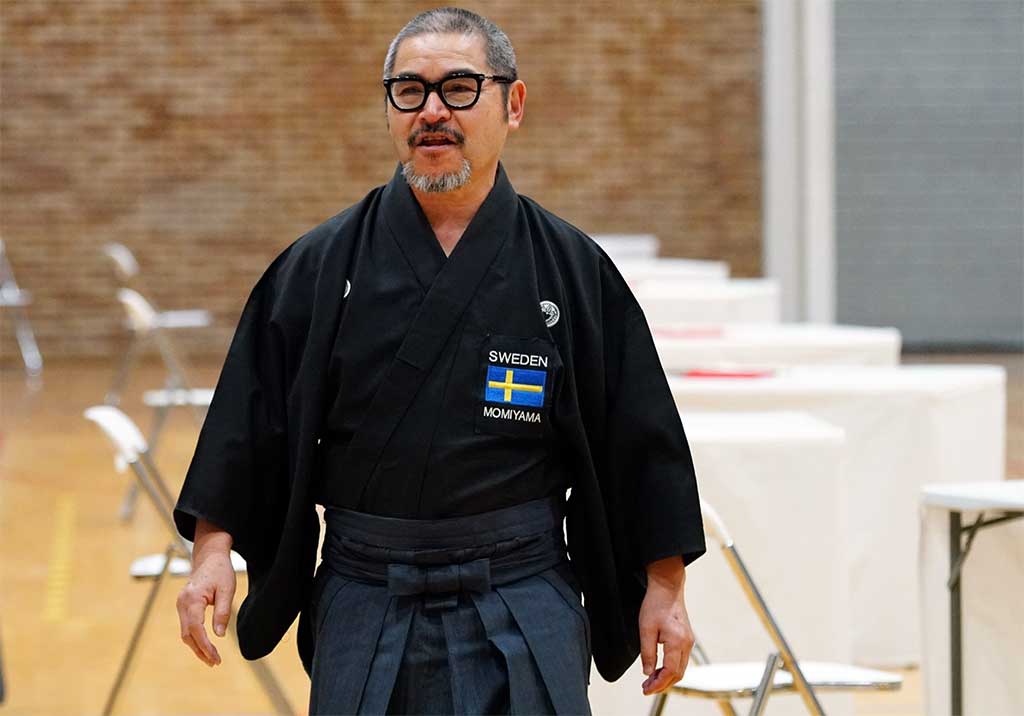
- Takao Momiyama s. (Iaido 7th Dan Kyoshi, Jodo 7th Dan Kyoshi, Kendo 5th Dan)
Q: What was the first EIC you took part in? Can you tell us a bit about your feelings and impressions you had back then?
Borra s.: The first EIC I attended as a delegation leader was the 2001 edition in Belgium. As a referee, I think it was the one in Bologna in 2005. The latter was a very engaging event for me since I was the CIK General Secretary: we were organizing it and it was the first time for Jodo and Iaido in Italy. From the organizational point of view it was very different from the current one; there was a large delegation of Japanese sensei including Ishido sensei; our experience as competitors was also quite limited. So considering all things I felt definitely under pressure from many points of view. I remember I was so tired at the end of the week.
Demuynck s.: In 1993 I participated in the first EIC in Sittard(NL).
In the previous years there had been some kind of “warming up” during the Duch open but now finally we could experience the real thing!
A huge japanese delegation had been invited and probably the most memorable fact was meeting O sensei (Ishido sensei senior) who was the head of the delegation.
Participating in this kind of huge international event was new to all of us and therefore the guiding & coaching of the Japanese sensei was much appreciated to help the European iaido community to move forward and improve in this type of events/organizations.
During the taikai itself, the judging panel consisted of Japanese sensei assisted by some higher ranking European teachers (Vitals,Hopson,Cook,…).
But the finals were all judged by the Japanese sensei.
Participating (as a 4D) in the first European Taikai meant a lot to me and others. Experiencing the thrill of a (almost) real fight, out of the comfort zone of the dojo, fighting a real opponent as he/she sat by your side… It gave iaido another dimension, making it more real, making it alive.
I still think it is a must for all iaidoka to participate in this kind of events, being judged, watching other competitors, and to really understand iaido and bring up the level of practice.
van Amersfoort s.: My first EIC was the 1st EIC in 1993 in Sittard The Netherlands. I became 2nd in the Yondan class. Final was against Patrick Demuynck the winner. Because the EIC was in Sittard and I was a member – together with Louis Vitalis sensei and Richard Boel – of the Technical committee on iaido and jodo within the Nederlandse Kendo Renmei (NKR), it was a busy EIC. Besides competing we (Richard and me) also had to do (together with Jolanda Dekker) a lot of work behind the screens. Personally I was experienced in competition in general because of my karate-do background. Therefore organizational wise there could be a lot of improvements being done in the future. But the reason I started kendo iaido and jodo was the (in)direct contact with Japan through Louis Vitalis sensei and therefore this was the opening for real deep Budo training. The driving motor in Japan behind this first EIC was definitely Ishido, Shizufumi sensei. Impression of the EIC in general: great fights by more or less “the second generation pioneers” of nowadays iaido in Europe. It was learning, learning and learning. The Budo information came to us by means of the ZNKR and various Japanese sensei’s never stopped so that’s how we were able to develop ourselves in Europe.
Momiyama s.: It was 1993 in Sittard, Holland was my first experience.
I had 4 dan. I have followed Ishido sensei’s group since I met European Iaidoka in England 1985. My Iaido grew with all senseis from Japan and all senpai in Europe. I was just happy to share and learn something more from the EIC event.

Q: For how many years have you been serving as a referee in the EIC?
Borra s.: Since 2005 I have always refereed the European Championships.
Demuynck s.: I have been serving as a referee since 2000.
van Amersfoort s.: If I remember correctly I started refereeing in the EIC when I stopped competing. Beside this I was in the nineties and beginning 2000 also the trainer / coach of the iaido and jodo teams of The Netherlands. I became 6dan jodo in 1998 in Japan – together with Louis Vitalis sensei – and in 1999 in Brighton UK 6dan iaido.
At the 6th EIC in Brighton UK in 1999 I became 3rd in the godan class. And after I did my 6th dan examination succesfully. So probably my 1st time officially refereeing was at the 7th EIC in 2000 in Sittard, The Netherlands.
My most beautiful iaido refereeing experience was together with Ishido sensei and Cook sensei. Ishido sensei was sushin. Competitors: Alan Nash and Patrik Demuynck. Ishido sensei voted for Alan. Cook Sensei and I voted for Patrik. Afterwards I got a deep lesson in refereeing from Louis Vitalis sensei personally. An unforgettable lesson. Looking at the whole Budo picture and it is not only counting and comparing the mistakes. So almost twenty years of EIC refereeing.
Momiyama s.: I can not remember exactly the year 1993 or 1994.
Q: How hard is your role?
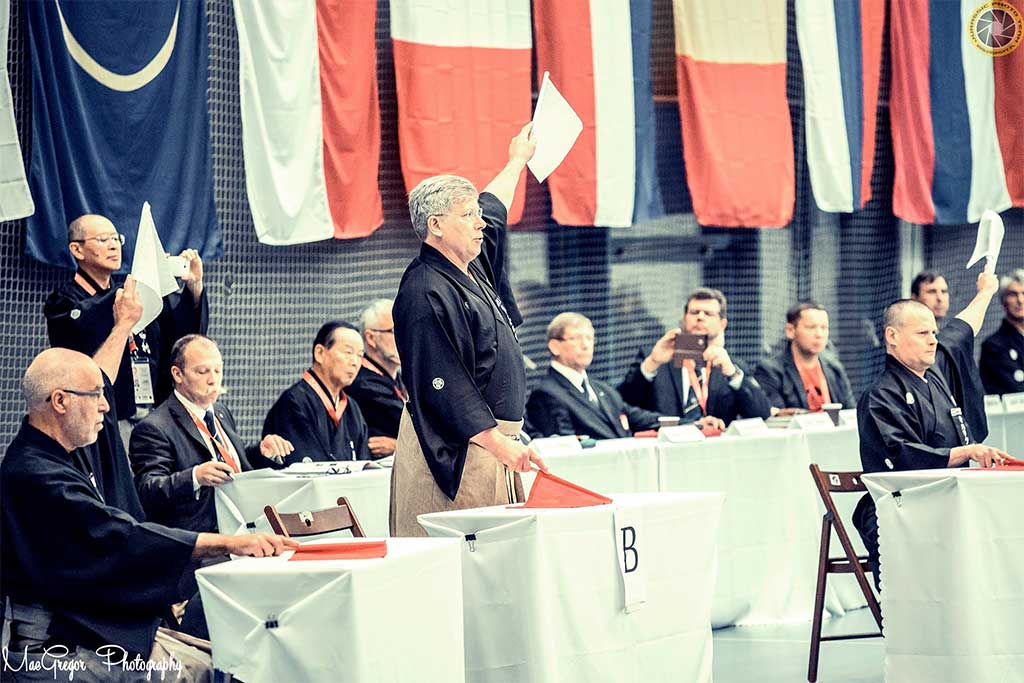
Borra s.: I find the task of refereeing very difficult. Very prepared people arrive at the European championship who perform a correct and high level Iaido. Often when a semi-final or a final is refereed the differences are minimal and it is difficult to raise one flag or the other. It is really necessary to observe the match with the utmost attention and with an open spirit and free of prejudices of any kind. As a referee it is necessary to study and train to referee but also practice a lot because we have a great responsibility and we have to update ourselves continuously. Unfortunately, the role of referees is not always interpreted in this way. It would be important to be able to do some refereeing seminars with Japanese sensei in addition to the two hours scheduled during the European Championship. For example, I remember years ago doing a seminar with Ishido sensei in Europe, in a simulated match he asked us to evaluate the mistakes of the two competitors, I had seen 9, he saw 42 of them……
Confronting in this way with people who have a depth of practice and a knowledge of Iaido unattainable for us can only help us grow.
Demuynck: Being a referee is very hard. One must be able to instantly judge the participants and most important is to know why you give victory or defeat. People from all over Europe come to participate in the EIC and there is no other option but making the right and well-founded decision. This means, as a referee, one has to continue training, studying and updating.
And hereby I repeat my pursuit that an annual referee seminar is needed to select competent referees (as done in Kendo) !
Because the level of the participants increases year after year!
van Amersfoort s.: Refereeing is hard, very hard. You need to be highly concentrated. And be fit, to be able to keep a correct body position during the whole EIC. You need to know the rules and regulations. You have to have a loud voice and good pronunciation to give the referee commands clear and transparent in such a way that you activate the players with your fighting spirit too. You need to be impartial. You mustn’t give in on your preferences. You have to have a keen eye to keep your accuracy. You have to work as a team with your fellow referee colleagues. You even have to educate other (younger) referees on the spot. Not always an easy job, but if you take refereeing seriously then you have to act every time when necessary to improve refereeing in general. Being sharp the whole EIC. If you relax too much then you will miss the opportunity to implement certain things on the spot. You are an example. If you do not fully do your best it will be noticed by the public. Impartial. Correct. Example. Etc. That’s why it’s hard. You can never relax. For me during refereeing at an EIC the Japanese verb JI RI ITCHI comes alive: Theory and Practise are One!
Momiyama s.: Until 2005 – 2007, my preparation period, I had a difficulty to make a decision quickly enough when I was sitting as referee. Also to check 2 players action at same time need many years experience at EIC events.
Q: During these years in your role, could you perceive any evolution of Iaido in Europe?
Borra s.: The European Iaido has grown a lot in recent years. I have been following the European Championships since 2001 and the level has changed a lot. We have all grown a lot in all countries and have been lucky enough to be able to do many seminars with Japanese sensei every year. Today we see 4th and 5th dan who are impressive for their abilities to express correct, precise iaido, with strong Kihaku and overall control that could not be seen years ago.
Demuynck s.: Yes, in Iaido there has been a huge evolution. The level of iaido has risen tremendously in these 25+ years. And this applies to all parties involved: organising federations, participants & referees.
van Amersfoort s.: A big evolution. More and more countries joined EKF and joined the European iaido Championships. Was it in the beginning mainly a battle between the countries where iaido more or less began. Through the years other European countries became stronger and the EIC situation changed very rapidly after I guess 2005. And this evolution is still going on. Thanks to everybody part of EKF who helps the development be continuous by training correctly like we learned from our ancestors.
Momiyama s.: Yes, a lot. The knowledge about ZNKR Iaido and different Ryuha of Koryu is increasing and the variation of many teachers’ teaching methods made the quality of techniques become very high in the last 6-7 years.
Q: In your opinion, how important is the EIC for the European Iaido?
Borra s.: I think it is important to meet every year and compare with the senseis, with the other referees and with the athletes. Often in Iaido, we see people who isolate themselves in their own dojo, always continuing to practice with the same group and without having exchanges with the outside world. Iaido is an individual practice and therefore it is easy to isolate oneself, but in the medium term this leads to an involution of one’s Iaido, we have had the opportunity to see it on many occasions. Participating in the European championships, on the other hand, is like opening a window to a different world from the one we are used to in our dojo. Confronting and seeing others iaido allows us to activate a mental opening that is difficult to achieve in any other way. I believe that the EIC has been a tool for growth for all of us and we hope to be able to resume it soon.
Demuynck s.: The level is growing in Europe, that’s for sure ! And the organisation of EIC most certainly is important for the European iaido community to keep on growing.
There is the tension of the competitions and there is the gathering of the participants. And there is also the latest evolution in the iaido techniques brought to us by a high ranking Japanese delegation.
EIC: a big European meeting with iaido minded people…
I really hope we can pick up the thread again next year.
van Amersfoort s.: Easy: very important! Modern Budo needs a way of competition. Actually in the old ages in or out of Japan a certain way of competition was always there. Human beings need to compete to be able to improve and to become better than yesterday. Without the EIC and of course all the other National competitions, iaido wouldn’t be so well developed and organized as it is now.
Momiyamas s.: It is very important for Iaido learners who want and need to meet other iaido learners at EIC to get new information and meet Iaidofriends. Exchange of each other’s knowledge for study Iaido at EIC is not able to be obtained by the internet or some other way.
continue reading the interviews ...