
Versione italiana: EIC - Interviste
Modern competitors:
- Andrea Cauda (Iaido 5th Dan)
- Chiara Bonacina (Iaido 3rd Dan)
- Lukasz Machura (Iaido 5th Dan)
- Piotr Kukla (Iaido 5th Dan)
- Stan Engelen (Iaido 4th Dan)
- Valentin Vervack (Iaido 4th Dan)
Q: What was the first EIC you took part in? Can you tell us a bit about your feelings and impressions you had back then?
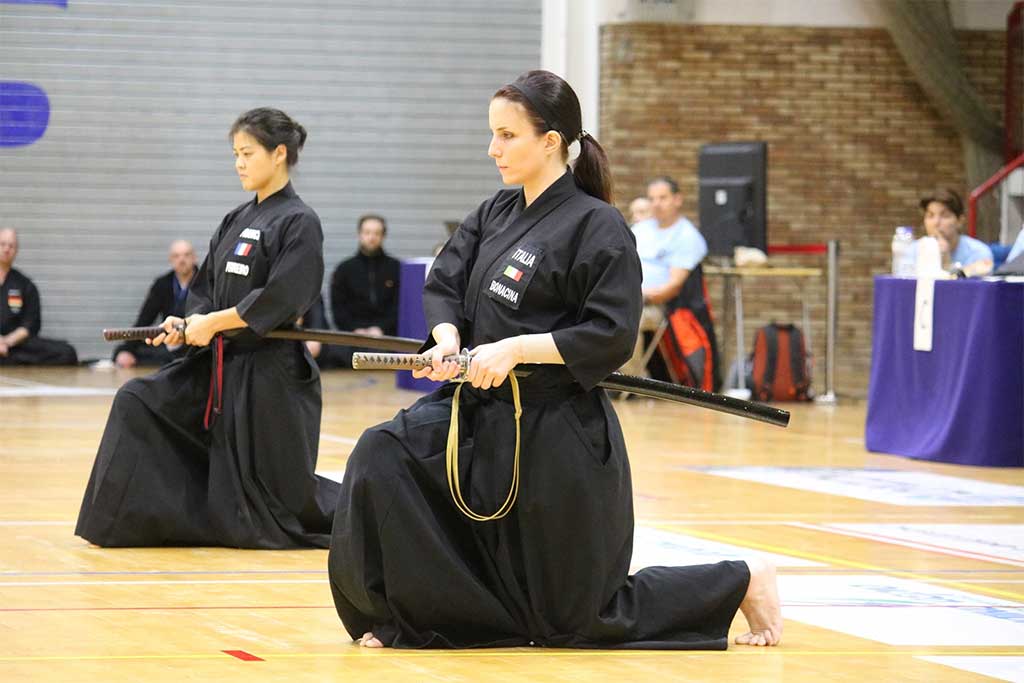
Chiara B.: It was in Mèze, back in 2013. I was a mudan at my third iaido competition. I was pretty agog. Even if my performance has been poor back then (…but the food was worse), I cherish the memory because it has been a true adventure with people that I have learned to call friends now.
Andrea C: The first championship I participated in was in Bologna, in 2005. At that time I was competing in the Mudan category, together with Christian Ibelli. At the time our Coaches were Franco Moretti and Detlef Uedelhoven. I had started practicing Iaido only a year before and I stopped in the quarter finals, to my great satisfaction! I remember that on that occasion the national team had done very well, winning many medals and Claudio had won in the Yondan category.
There had been a wide range of emotions, all very intense: taking part in an event of this magnitude, seeing Ishido sensei for the first time (at the time he was part of the ZNKR delegation), feeling as part of a group of great people and practitioners, from which I tried to learn as much as possible, and to perceive an atmosphere of general friendship in which it was really easy and natural to get to know and become familiar with people of different nationalities, it was certainly priceless and unique.
Lukasz M.: For the first time, I took part in a 2006 event in Brighton, UK. It was a joint 13th EIC and 5th EJC event and I was lucky to represent Poland in both. I didn’t know what to expect, at all. I knew that this would be a rather big event, with a lot of high-level iaidoka of which some I knew already from some seminars in Europe, but it turned out to be considerably larger. That was the time I met many future friends and rivals for the first time.
Piotr K.: The first EIC I had the chance to participate in was the EIC in Brighton in 2006. I really got lucky, as it was the first year the Dutch team sent two people in a grade. I was shodan and still very much new to iai. It was an amazing experience! So many people, so much beautiful iai… It was overwhelming. It really felt incredible to be able to participate in such a great event. For me personally, it did not go too well: I had slipped in my first match, and I was still rather upset over that during my second match… I ended up losing both, finished last in the pool, and that was the end of the championships for me. I was disappointed because I believed I could show better. Luckily, there was a lot to watch, to see and to learn from with all the other matches and the team competition and exams the next day. Despite the initial let-down, I was very grateful to the team coach for giving me the opportunity.
Stan E.: My first experience at the EIC was actually not as a competitor, but as a spectator back in 2009. I had just started iaido a couple months before and I was very excited to find out that the EIC was going to be held in the Netherlands, in Mierlo. Mierlo is a couple hours from Amsterdam by public transport, so I took the first train that morning to be on time and take pictures all day.
There, I was amazed by the level of iai that I saw, performed by people from all over Europe. I was deeply impressed by seeing so many people from so many different countries united by their passion for iai, how they interacted so kindly with each other and with the Japanese delegation, how everyone and everything in the hall seemed to have its place. I also got to meet many of the Dutch team members and members of the Dutch Shinkage ryu family. Although I was a complete beginner, they welcomed me warmly and were happy to provide me with the necessary subtitles to explain what I was actually looking at.
The atmosphere in the hall was something I had never experienced before, but somehow it felt amazing and I knew that this was something I wanted to be part of. On the train ride home, I made the promise to myself to train hard and do my best to get selected for the national team. A year later, I participated in my first EIC in Paris, as a mudan competitor of the Dutch national team.
Valentin V.: My first EIC was in 2010 in Paris. It was a very exciting time for me as It was only my second year doing competition. As the budo world was still very new for me and my family, we were all very proud of me being selected. Being my first time and having my family watching me doing serious iaido for the first time made it extra special. Thinking back, I was very nervous seeing the european level, but I was lucky to be surrounded by a good team with good friends who could guide me.
Since it was my first EIC I was surprised to get as far as I did and I will never forget the feeling I had then. I have been chasing that feeling ever since and try to have it back at every opportunity.
Q: What is your most memorable moment?
Chiara B.: When someone thinks about EIC, the first thing jumping to their mind is, usually, high level competition. But this isn’t very exhaustive, is it? EIC is a big event made of training, testing personal limits and enjoying good company. It won’t be wrong to state that EIC are made of people. These people change every year, not only because you can always see new faces, but because as time goes by, year by year everyone improves, grows, learns. It’s hard to choose a “best” memory, mainly because I’ve never lived the EIC as a moment just for me myself and I. I do not have, in fact, a “most memorable moment of mine”. I’ve always enjoyed EIC as a part of a unified team with a big chance to improve, as the delegate of my home country for the dan grade I had at the very moment. My last experience in Athens 2019 shines particularly bright in my heart, not only for the results of our team or the joy that irradiated me when I had the chance to spend some time with foreign friends that I’m now missing terribly, but also because I’ve had the chance to see my sensei winning his last rokudan competition, playing his last role as the team coach and passing his nanadan examination. If there’s any lesson to learn during these peculiar times, it’s that all is transitory, life and practice are complimentary, and back then I’ve experienced both truly.
Andrea C: There have been many memorable and unrepeatable moments. From the satisfaction of winning the first matches, the first medals, to seeing your teammates united towards a goal, to the Sayonara party where everyone abandoned their “composure” to have fun together. These are memories that I will always carry with me.
I cannot deny that the 2009 victory in the Netherlands, both in the individual and in the team competition together with Claudio, Battista and Valentini, gave a considerable shock to my path. I have always loved the competitive part of sports in general and Iaido, but fortunately, having always participated in competitions since I was a child, and having lost countless times, I have learned to accept defeats willingly, not being influenced by negative feelings or thoughts.. Losing is just another way to win. It has always helped me to seek new stimuli, to want to continually improve and accept the “success” of others as an integral part of life itself, in all sectors.
To conclude, among the memorable moments it is a must to include all the training sessions, the meetings, the preparations, the beers of the night before that have characterized every European championship in which I have taken part, together with my teammates and friends of the national team. Without each of them, and without sharing these glimpses of life, the meaning would have been very different.
Lukasz M.: Don’t remember too much as that was 14 years ago… I can recall two things actually, both funny. One was at the tournament itself, at my first KO match ever. I was against a girl, unfortunately, do not remember who she was. One of the kata we had to show was Soete Tsuki. I was extremely nervous and in the final moment when I did noto, I lost control of the sword. Somehow it flipped around and landed with a blade on my left hand. I managed to pull it normally, flip over to the proper position and finish my noto in one single movement. Lucky enough I was using iaito 😉 Somehow I won that fight, probably because I was at the right-hand side (red) court, so with my back to the two of three shinpans… The second moment I won’t forget was an evening party at the UK team dorm on Sunday. Legendary.
Piotr K.: Regarding the EIC, that would easily be the instant three white flags went up in the godan final in 2016. That moment of disbelief – “is this really happening??”.
The best part was during the award ceremony, when I walked up to the sensei. At that time, so many friends from all over Europe were cheering me on; I felt so much love from the crowd. It really gave me a huge lump in my throat.
Stan E.: Besides the many (im)memorable moments during the sayonara parties, the 2017 EIC in Torino was a game changer for me. At the time, my mind was clouded with a number of things. Within the tradition of me getting injured right before the EIC every year, complications arose from a heavy bike accident I had in 2015, which nearly kept me from participating. Next to that, this was my first time competing in the yondan category. Which meant I was competing against iaidoka I had looked up to since I first saw them perform at the EIC 2009. Also, I would have to perform two koryu kata in the knock-out phase, adding an extra layer of pressure to represent Matsuoka sensei and Kinomoto sensei in front of the shinpan and Japanese delegation.
Seeing the taikai roster filled with big names, my main focus was to survive my pool, perform shinkage ryu and go down with guns blazing. Going up against iaidoka I highly admire meant I had nothing to lose and I was free to give it my all. In the end I found myself in the final against Adam Bieniak, to whom I lost in the pool that morning. I gave it my best, put all I had left inside me into the last cut of sougiri and felt for the first time during a taikai as if I had cut my kasouteki. From not winning a medal in seven EICs prior, I won the gold in Torino.
Concluding (finally), my most memorable moment has to be at the EIC 2017, going up against those I admire greatly and growing through them in every consecutive match, from the first to the last. In this tournament, I truly felt like it could have been any of us taking the gold. I happened to be the lucky one this time. Having the opportunity to train together, go up against each other at the EIC and grow as a budoka is a big reason for me to strive to make it to the national team every year. It’s a pleasure seeing everyone at the EIC every year, and I miss you guys and girls greatly!
Valentin V.: My most memorable moment in an EIC must be the first match in the individuals I had against Jesper. It was also my first time doing koryu in an EIC. The pressure in that match was enormous for me just because I knew the level of my opponent. I think this must have been the closest I have ever been to feeling how a real duel must feel like… Incredibly I won the match but I was so drained afterwards I couldn’t find the focus for the next match which I lost I believe.
Q: During these years as a competitor, could you perceive any evolution of Iaido in Europe?
Chiara B.: Definitely. As I am slowly climbing the Dan mountain, I feel pressure coming from below, kohai are biting our feet and senpai are climbing always higher and they’re becoming harder to reach. It’s really stimulating.
Andrea C: Absolutely and fortunately, I feel like saying. It means that there is a continuous research in Europe and the desire to improve. In recent years, especially in the lower grades, the level has grown a lot and you can see it during team competitions where having a few more dan does not necessarily imply winning against your opponent. This can only help raise the bar more and more.
Lukasz M.: I don’t think you have to be an EIC competitor to see the ever-growing average level of iaido in Europe, but it’s indeed easier to notice it at the championships. I can see a present serious approach to EIC and the structure of inter-country coaching built now into almost all the teams. Fortunately, in Europe, the iaido community is still a relatively small group where the social element still seems to be more important than the competition and keeping these close relations are equally important to the tournament. At least for me.
Piotr K.: I have often heard that the level within the grades has increased over the years. Despite feeling it to be true, I cannot give an objective answer, as I have not really been an observer in that context. What has been noticeable to me is how there are more and more younger people among the higher grades compared to when I started. I think this is a good evolution in the longer term. Another positive change, I think, is that the various ryuha have become more pronounced in the EIC. It makes it so interesting to see so many different forms and approaches to the sword.
Stan E.: As you know, evolution takes quite some time. In my limited experience of competing at the EIC from 2010 to 2019, I feel like I can only really speak for the participants of my own EIC generation; those who started around the same time and have walked the same path somewhere else in Europe, guided by different sensei. I’ve only started to get a slight insight into the iai of the higher dan grades recently, so I am not quite sure yet how different our experience of trying to attain that higher level is from theirs.
All I can say is that I feel like the involvement of our respective Japanese sensei with lower graded iaidoka, who are yet unburdened with responsibilities of teaching and running a dojo, has given the younger generation the chance to adopt the iai of Japanese sensei at an earlier stage. That is why I think we see more and more amazing iai at the EIC from lower graded participants every year. This has only been possible thanks to the teachers who have paved the way in the pioneering days of iaido and the EIC itself. Which is something pioneers are still going through of course in countries where iaido is still in an early stage of development.
In that sense, I feel like iaido in Europe is maturing more and more.
Valentin V.: Difficult question… as I am evolving with it too, I hope. Anyways my perspective on Iaido changes as I get older and more experienced. In the beginning I was chasing to be as good as “that one guy” or to get every kata as precise as possible. Nowadays I try to focus on making my kata more realistic as a budo, which will weigh on my precision… sometimes I wonder if the path I’m walking is the correct one as I feel it’s somehow different from what I see happening around me. But one thing I can say that hasn’t changed is that I still look up to the same people I did in the beginning, so we seem to evolve together.
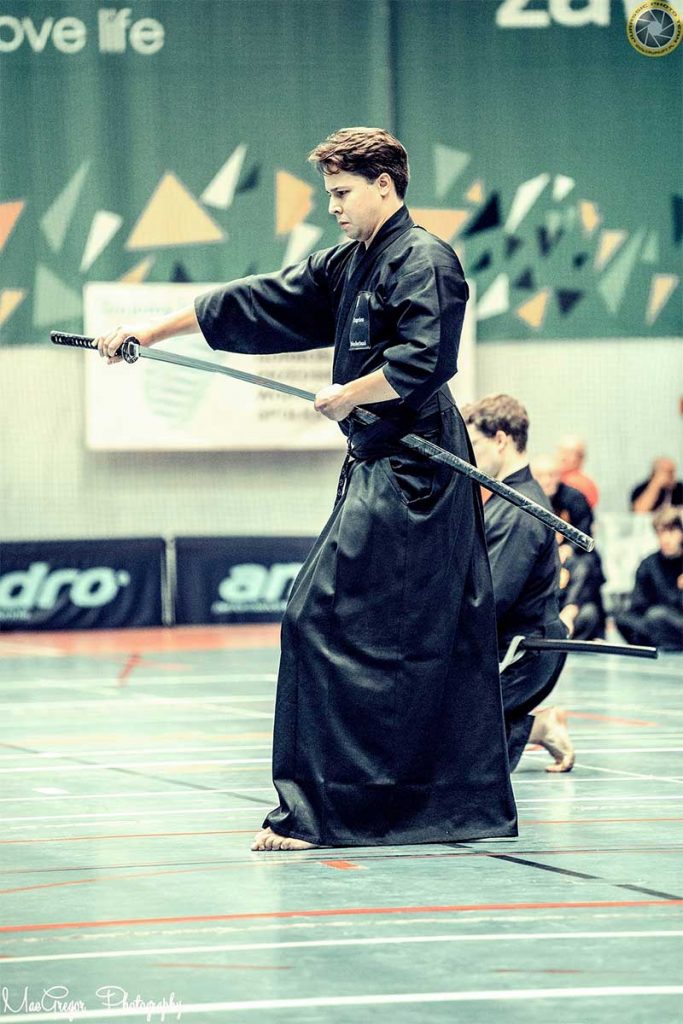
Q: How do you prepare, both physically and mentally, for such events?
Chiara B.: The only way to prepare properly is keiko. Since I know that anxiety will strike anyway, I always try to keep a balanced diet before a competition, and I put in practice different techniques of progressive and isometric relaxation that I’ve learned by putting myself in situations out of my comfort zone. Listening to music helped me in the past, but it’s not enough. Anna, who has been our team manager back in many EIC years, knows that half an hour before any shiai I tend to disappear because I need to practice kata. The only way to overcome fear is to face it, no shortcuts.
Andrea C: After many years of competing and with the increase in experience, everyone finds their own way to prepare themselves better, adapting to themselves what they find most functional. Assuming that training is fundamental and the basis from which to start, certainly participating in other competitions during the year also helps, over time, to learn to manage all the emotions that emerge and any “unexpected” that can always happen. I have personally noticed that too much physical and mental investment and the consequent overload (if you pay attention you can see in people’s faces and gestures during these events) does not bring the best results. Over the years I have always tried to welcome inside myself and accept without too much judgment every moment of the Championships, treasuring the defeats and also enjoying the victories and successes. Taking everything as it came, but not with a passive attitude, quite the opposite: to do this, you need a lot of training! I think the important thing is not to get invested and not to fall into easy negative thoughts, which only risk taking us off the Path and losing the sense of purpose of competitions in this Martial Art.
Lukasz M.: In fact, I don’t. Henry Schubert who is my iaido teacher always told us that any embu, whether it’s shinsa or shiai, is just a different type of training. More demanding as it drives you away from your comfort zone, but we shouldn’t take it any special. I believe he is absolutely right. Also, I don’t think you can prepare mentally for what is about to come when you’re going to take part in EIC for the first time. I’m nervous before every single fight for the last 16 years and not expecting this to change soon.
Piotr K.: There are the obvious joint team practice events we hold in the Netherlands, as many other countries do, and of course practising as much as possible in the dojo and attending seminars where possible. Apart from that, it has helped me to take better care of myself – things like sleeping well, eating well, getting stuff done (work, personal matters) before leaving for the events so that there is less weight on my shoulders. One perhaps peculiar thing is that I try to avoid knowing who will be in my pool at the start of the matches. I have noticed that when I know, it makes me nervous, because everyone is so good; but when I don’t know, it takes away that stress. I have sometimes even managed to only find out who was in my pool when we were greeting before the matches, haha.
All this is before the event itself. During the championships, I try to pick up what I can from the seminar, but I also really enjoy spending time with my teammates and the other competitors; it helps me relax, too. On the day of the championships, I try to relax but also give it my all, of course. I tend to seclude myself a bit from the crowd and try to focus and empty. What has also helped me in the past years is to simply enjoy the matches, and even to see them as preparations for the next grading. This takes my mind off of the stress of the competition – but only to some degree, obviously.
Stan E.: I’m sure there’s a Japanese equivalent for this somewhere, but ‘Mens sana in corpore sano’ is a phrase I have now learned to live by. I am able to perform best in life and budo when my mind and body aren’t held back by physical limitations. Through ups and downs, I’ve learned that I cannot solely focus on mental preparation, when my physical preparation is severely lacking. And vice versa, I’ve learned that my mental state greatly improves when I work on my physical preparation, mainly through a stable rhythm of keiko, (kihon) exercise, food and rest. Besides, when I am in a good physical state, my body will not abandon me during the taikai, even when my mind sometimes might.
What helps me to prepare mentally and get into a good state of mind before the taikai is listening to music and, if my snoring roommate allows it, a good night’s sleep!
Valentin V.: Surely, I try to keep my keiko moments as constant as possible throughout the year (something that has been difficult since I became a father). This was different in the first 4-5years I started Iai. Than I did regular training of 2 times per week. But in the 2-3 months before the EIC I would train 4-5 times per week.
The last times I participated I prepared by trying to do taikai with dojo members and find the right mindset. Also work more on the koryu and the logic of the kata as a budo.
The night before any EIC, and this is no secret, we usually just drink between friends to forget what we have to do the next day, but even more to get into the right mindset and feel the support of your teammates and/or opponents.
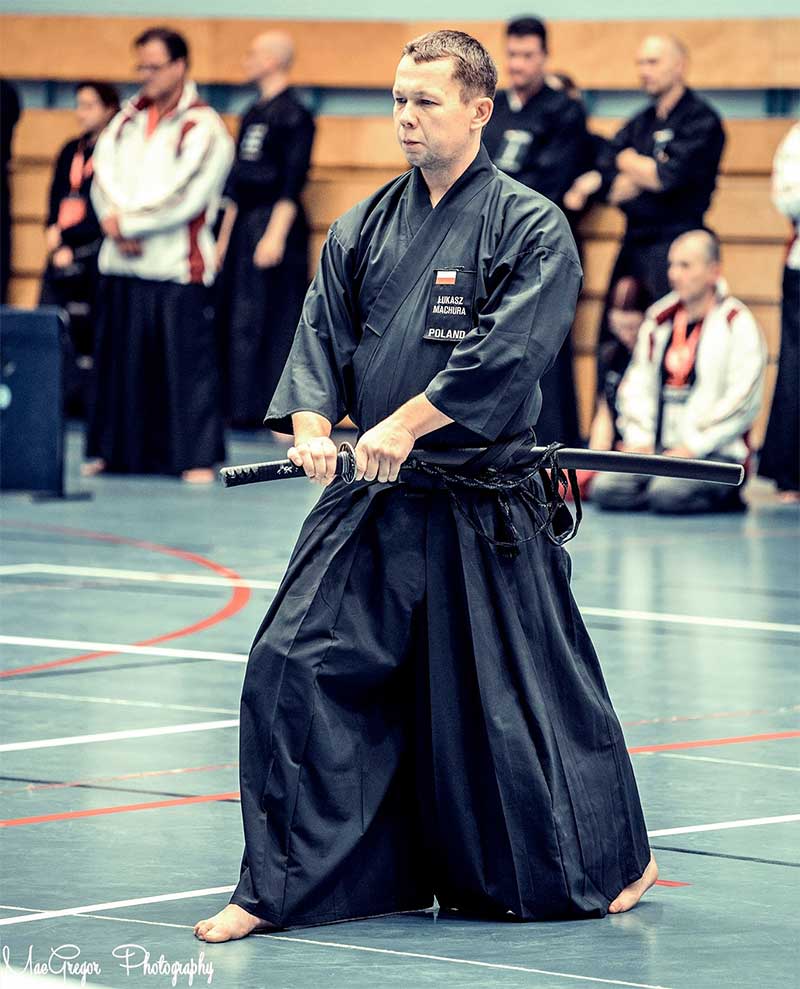
Q: What role has the EIC played in the development of your Iaido?
Chiara B.: When you’re a kid and you taste pizza flavoured crackers for the first time, they taste amazing to you, like if nothing could be better in the world. Then you try to cook your first frozen pizza and it tastes even better. And when you try your first pizza in a pizzeria, guess what? You forget about the cracker and the frozen pizza standard. Currently, EIC to me represents the best iaido scenario I’ve ever afforded. I’m sure that in Japan I’d be even more amazed. Provide yourself with as many good examples as you can to increase your chances to understand what is correct and worth to be reached in your iaido study. EICs are excellent, for this goal.
Andrea C: Like any event in which many other Iaidokas and senseis are present and there is the possibility of confronting each other, I believe it is fundamental to grow in practice. Remaining anchored to your dojo, without going out of your patterns and limits, leads nowhere. The Championships have always been a huge stimulus, but in particular seeing people dear to me over the years and the increase in participants and countries has brought me great satisfaction and pride in what everyone has done.
My invitation and my hope is that most practitioners understand the importance of attending such events, a little bit away from the unpleasant idea that the national team is only for the usual, “chosen” few.
I ask a critical question: maybe, if on some occasions the same people have always been selected, will it not be because they participate in so many events, they question themselves, and in this way, they grow faster, with more “hunger”? If it were assumed that to improve it is also necessary to compare oneself with others, to see with one’s own eyes what is outside of one’s own dojo, probably someone else would have taken part in these wonderful experiences, expanding the group and making known to as many people as possible what it means to be the national team. And, for me, there would be nothing more beautiful.
Lukasz M.: EIC became a really important event for me, the one I wait for the whole year. For many reasons, some described above. Meeting all these amazing iaidoka which you can find everywhere around Europe is something that simply motivates me most. You know, I’m trying to meet that level which is now set by players like Jesper, David, Sida, Jonathan or Adriana… I love to watch them, analyse what they do and try to recreate that in my training. Not always the whole kata, but rather their selected movements or techniques. And I simply like to talk and party with them all.
Piotr K.: I am nearly ashamed to say that the EIC has initially been a substantial part of what has motivated me to practice more and harder. That bit of competitiveness made it very interesting and helped me go beyond my intrinsic motivation. With the years, the realisation of the added knowledge from the seminars and of the practice to learn to cope with pressure were added to the competition. And as friendships arose with the people attending, so too joined the motivation to see friends again; to see how they had worked and improved, and to enjoy a competition together. As I mentioned before, a substantial motivation was added in recent years in the form of practice for shinsa. I find it very difficult to get that pressure and stress when practising in the dojo, and competition helps me find that point of stress to learn to cope with my nerves. Now for the actual grading…
Stan E.: Without the EIC, I would not have had the opportunity to meet so many people from all over Europe, coming from various (koryu) backgrounds, sharing the same passion for iai, motivating me to raise my level every year. Although of course, in the long term my greatest development comes from training with sensei and regular training in the dojo, the EIC forms a tremendous boost in a very short period, where I get to put my training into practice together with a team of amazing people. It has always been one of the main highlights of the iai calendar and I hope we will get to see each other safely with a sword or beer in our hands again soon!
Valentin V.: Oda sensei always spurred us to engage in taikai to try and feel what a real fight would feel like. The tension one feels during a fight makes you do weird things as we can often see at eic or exams. Mistakes are made and in a real fight can be mortal. Our everyday keiko was designed to be able to react in some specific situations to some attacks, but we always train in the safety of our well known dojo. By getting out there in the shiaijo, we can test ourselves and see where our keiko has brought us at that timeframe. For me that’s it. Same for shinsa, they are checkpoints I make myself go through to be sure I don’t stray from a certain path. This doesn’t mean I have strayed from my path if I lose. But this could mean that I should find answers in another way…
In total I think doing taikai at EIC has been the hardest way of training with everyone that practices ZNKR iai and I see every opponent as a fellow student with the same goal. We all help each other reach the next level by learning from our wins and losses. For that I have a big respect to all practitioners and also want to thank everyone who has contributed to my evolution in Iaido.